As the organizer of Toronto's largest outdoor community, I think a lot about how real friendships form. Since July, I've been reading the subreddit r/TorontoHangoutFriends closely, looking for any post that mentions hiking. On this sub alone, there's been roughly 200 posts in just four months.
Almost none of them are really about hiking. They're about the same thing, written 200 different ways: "I moved here for work and don't know anyone." "My friends scattered after university." "I work from home and haven't made a new friend in years." "We're a couple in our thirties and can't find other couples."
If that sounds like you, the first thing to know is that it's not a you problem. Making friends in Toronto as an adult is hard for reasons that have very little to do with your personality, and more to do with how most of us go about it.
Because friendship takes far more time together than most adult social formats ever give you. Research from the University of Kansas found it takes around 200 hours together to turn a stranger into a close friend, and most of the ways we try to meet people (an app match, a one-off meetup, a single coffee) deliver an hour or two with someone you may never see again.
Add a big, spread-out city, long commutes, remote work and busy calendars, and you get what Toronto Foundation called "Toronto the Lonely" in its 2023 Vital Signs report, which found 37% of Torontonians felt lonely at least three or four days a week. That's not a niche problem. That's more than a third of the city.
Read enough of these posts and the patterns jump out.
Life moved, the friends didn't. The most common story is a move: to Toronto for a job, from Montreal or Kingston, or from another country entirely (the UK, the US, Australia). The second most common is a life change: graduating, a breakup, friends having kids, switching to remote work.
People want something recurring. Post after post asks for "a regular group" or "something weekly", not another one-off event. People have figured out, correctly, that seeing the same faces again is the bit that matters.
The follow-through problem is real. One poster shared a three-day update on their own friend-finding post: a handful of comments, a few DMs that went quiet, an Instagram swap that led nowhere, and exactly one person who actually met up, for a game of Catan. Others describe the same thing on Bumble BFF and 222: lots of matching, not much meeting.
The trail isn't the obstacle. People name the places they want to go: Rouge Park, the Humber River, Elora, Algonquin in the fall. What stops them is having people to go with, and often a car. More than one post describes friends who were too busy, or too intimidated, to come along.
Jeffrey Hall's study, published in the Journal of Social and Personal Relationships in 2018, put rough numbers on it:
The kind of time matters too. Hanging out, joking around and doing things together counted. Time spent working alongside someone counted for much less.
Now run your own numbers. A weekly 90-minute coffee gets you to "casual friend" in about eight months, assuming nobody cancels. A full-day hike is six or seven hours of walking, talking, eating lunch somewhere scenic and sitting in a van going home together. A weekend camping trip packs more waking hours together than three months of weekly coffees.
This, in my mind, is the single biggest reason outdoor communities produce friendships that last. Not magic but shared interest and time together.
Just like a fire that needs, heat, oxygen and fuel to get going, you need all three for real friendship to form:
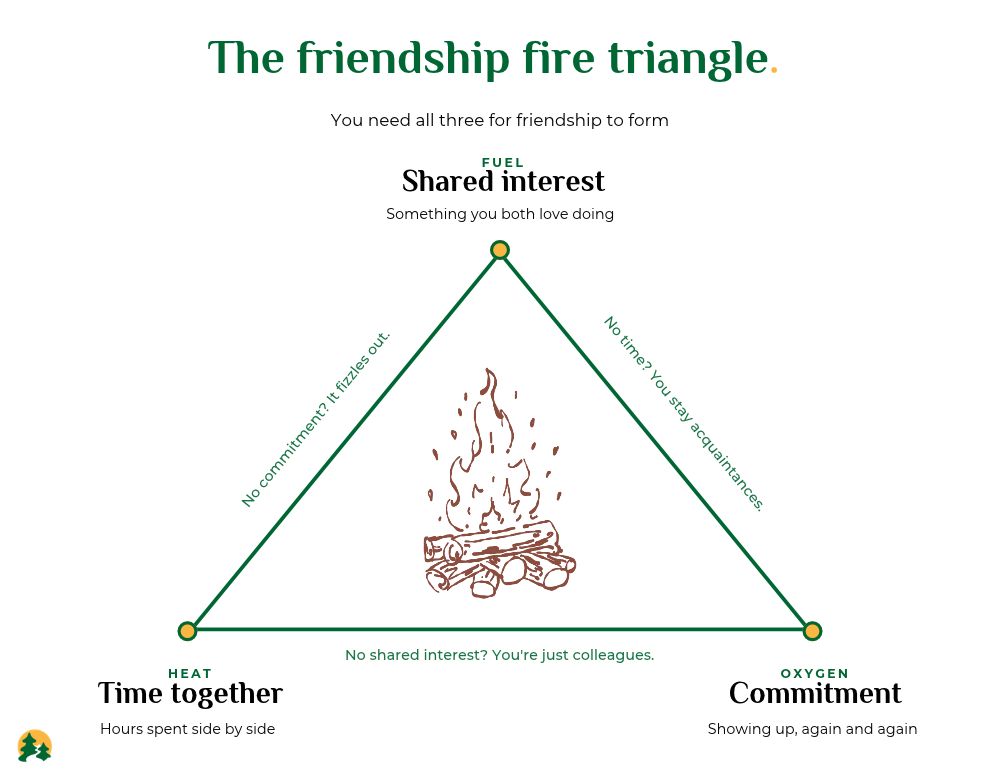
Shared interest
Pick something you're personally passionate about. This is so important because A. it means you're actually excited to attend B. it means you'll be around likeminded people who likely share some of your values and C. in the worst case scenario that you don't meet anyone, at least you'll have had a good time.
Time Together
One great event won't do it. Choose a format where the same people show up again and again: a rec sports league, a run club, a choir, a volunteer shift, a membership community. Remember, it takes 50 hours just to become a casual friend so that means you're going to have to put some time in.
Commitment
This is both commitment to whatever you've chosen but commitment to the process. Feel like people are really flakey? That's because they're missing the commitment. You want to join something that requires it and look for the people who display it. These will become your friends.
Do things side by side, not face to face. Sitting across from a stranger with a latte is a job interview. Walking a trail next to them is easier. There's always something to talk about (the view, the mud, the dog that just ran past) and silence isn't awkward.
Go long. If you want to compress the timeline, choose formats that give you a whole day or a whole weekend with people. Day trips, camping weekends and multi-day trips bank hours that a weeknight drink never will.
Be the one who makes the second plan. The pattern I see at WU is that the first meeting is never where friendship happens. It's where you figure out you like the vibe and like the people. After that first meeting, there are people you like and will recognize but it's the follow-up that counts. If you clicked with someone at an event, suggest the next one before you go your separate ways. Most people are waiting for someone else to ask.
Meet in a group first. A lot of these posts include some version of "please don't message me if you're looking to date." A group setting with an organiser takes that pressure off, and it's safer than meeting a stranger from the internet one-on-one. For couples looking for couple friends, it's the easiest route too: you both meet a dozen people at once and see who you click with.
Toronto has no shortage of options. The trick is choosing the ones with a built-in rhythm:
We've written a longer breakdown of the options, with honest pros and cons, in How to Make Friends in Toronto, and a guide specifically for going hiking in Toronto when you don't know anyone. If transport is the barrier, here are the best Toronto hikes you can reach by TTC or GO.
Wilderness Union exists because of exactly the problem in those 200 posts. We built a community for people whose shared interest is the outdoors and they want people to do it with. What's made us so successful at creating real friendships is being deliberate about building that community. We hear that you want to meet people at a similar stage in life, particularly from women, that you need to feel safe. We've made the sometimes controversial decision to split our groups by age. Our main community is aged 20-45 and we're now introducing a 45+ community.
For both, you need to be a member. Even a free membership means there's some kind of commitment which takes removes the general flakiness you otherwise find. As for safety, we vet everyone on our overnight trips and keep a close eye on member behaviour. When somebody's not a good fit, we gently tell them.
Every trip is guided, and we handle the transport from the city, the gear and the logistics, so you don't need a car or friends who are already outdoorsy. You just show up. And because members come back trip after trip, you see the same faces across a season, which is exactly what the research says you need.
During the week there are member clubs too, including our run club, so the hours keep adding up between trips. And we hike right through winter, which matters in a city where social lives tend to hibernate from November to March.
Most people come not knowing a single person in the group and leave with a friend group they didn't see coming.
We have a free Crew membership and, for those who want to really bake the outdoors into their lifestyle, a paid Explorer membership that makes it affordable to come out more. Join here, then check out everything that's coming up.
Is it hard to make friends in Toronto? Yes, for most adults it is. Toronto Foundation's 2023 Vital Signs report found 37% of Torontonians felt lonely at least three or four days a week. The people who succeed choose one or two recurring groups and keep showing up.
How long does it take to make a friend as an adult? Research from the University of Kansas suggests about 50 hours together to become casual friends, about 90 hours to become friends and more than 200 hours to become close friends. Activities that give you long stretches together, like day hikes and camping trips, get you there faster.
Why do people never follow through on friend-finding apps and Reddit? Messaging is low-effort, so lots of people start conversations they never finish. Formats with a fixed time, place and organiser (a league, a club, a booked trip) remove the planning step, so people actually turn up.
How do couples make couple friends in Toronto? Join group activities together rather than trying to arrange couple dates with strangers. Group hikes, rec leagues and member communities let you both meet lots of people at once and see who you click with.
How do you make friends in Toronto in your 30s? Choose recurring, activity-based groups aimed at your life stage, and prioritize longer formats like day trips over quick drinks. In your 30s, time is the scarce resource, so get your hours in bigger blocks.
What's the best way to meet people outdoors in Toronto without a car? Join a guided group that provides transport. Wilderness Union runs trips out of the city with transport included, and there are also hikes you can reach by TTC or GO Transit.
Toronto is a hard city to make friends in, but it rewards the people who keep showing up. Pick your thing, go three times, and see who's still there. We hope to see you out there.